Goal Setting
How to Pick the Right Accountability Partner (Without Regret)
The wrong accountability partner kills momentum fast. Learn the traits to look for, red flags to avoid, and a simple test to find someone who actually helps you stay consistent.
 6 min read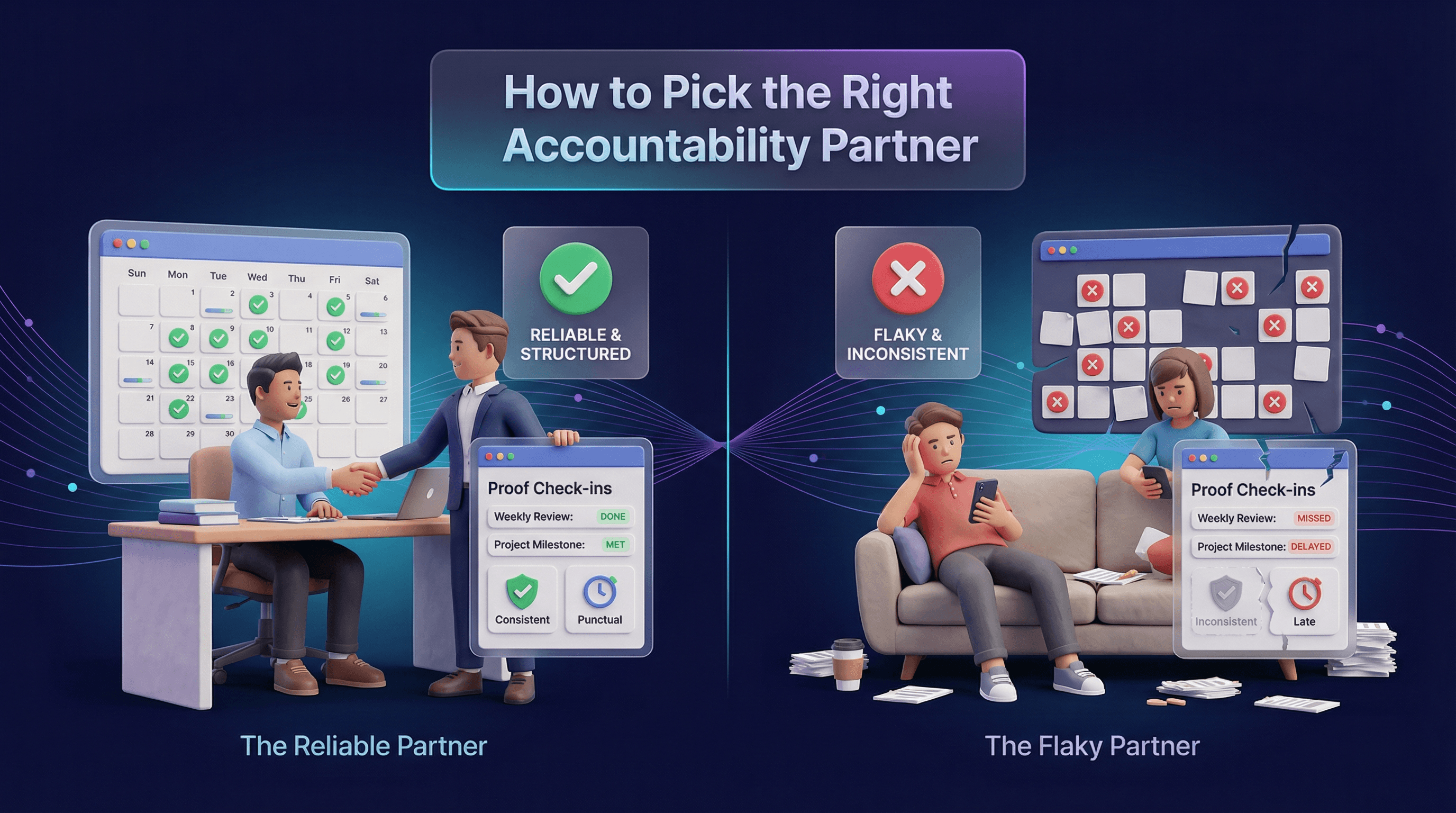
Your system is only as strong as your accountability partner.
Pick wrong, and your check-ins become casual chat. Pick right, and your consistency changes fast.
Choosing the right person is arguably the most important decision in your entire accountability system. A great partner won't carry your goals for you — but they will make it much harder to quietly quit.
What Makes a Great Accountability Partner
Look for someone who is:
- Reliable with time — they show up when they say they will
- Honest about missed commitments — theirs and yours
- Structured in updates — they care about proof, not just words
- Reciprocal — they hold themselves to the same standard they hold you to
You need standards, not just encouragement. A partner who always says "it's okay, you'll do better tomorrow" is comforting but not effective.
The 5 Types of Accountability Partners
Not every partner looks the same. Understanding these archetypes helps you find the right fit.
1) The Peer Partner
Someone working toward a similar goal. You both check in, share proof, and push each other forward. This is the most common and often the most effective type because the effort is balanced.
Best for: Gym goals, study routines, content creation, daily habits.
2) The Mentor Partner
Someone further ahead in the area you're working on. They've already solved the problems you're facing and can offer shortcuts. The risk is the relationship becoming one-directional.
Best for: Career goals, skill-building, business milestones.
3) The Buddy Partner
A close friend who agrees to hold you accountable. The upside is high trust. The downside is many friends avoid honest feedback to protect the relationship.
Best for: Low-stakes habits where encouragement matters more than pressure.
4) The Stranger Partner
Someone you don't know personally but share a goal with. Surprisingly effective because there's no social baggage — you can be fully honest without worrying about the friendship.
Best for: High-friction goals where you need objective feedback.
5) The Group Circle
A small group of 3-5 people holding each other accountable. More diverse perspectives but requires stronger structure to avoid diffusion of responsibility.
Best for: Long-term projects, 30-day sprints, and goals that benefit from multiple viewpoints.
Red Flags to Avoid
Avoid partners who:
- Cancel check-ins often — unreliable attendance signals low commitment
- Accept vague "I'll do better" updates — this enables drift
- Over-criticize without helping fix the system — accountability is not punishment
- Want accountability but resist being accountable — one-sided effort always fails
- Compete instead of collaborate — they make it about winning, not improving
Mismatch is expensive. If you see these signs, don't wait three months to act. Replace quickly.
The 10-Minute Partner Test
Before committing long-term, run this 7-day trial:
- Set one small goal each
- Agree on a check-in cadence (daily or 3x/week)
- Require objective proof — a photo, screenshot, or log
- Hold one end-of-week review together
Scoring the test:
- Both completed all check-ins with proof → strong match
- One person missed without communicating → warning sign
- Check-ins felt like obligation, not structure → wrong partner
- Both showed up and adjusted when needed → keep going
If both people complete the process honestly, continue. If not, move on without guilt.
Set Expectations Early
Define these rules on day one:
- Check-in frequency: How often and at what time?
- Proof standard: What counts as evidence of completion?
- Miss protocol: What happens when someone skips?
- Recovery plan: How do you restart after falling off?
- Review cadence: When do you evaluate and adjust the system?
Ambiguity kills partnerships. The more explicit your agreement, the less room for confusion.
Online vs. In-Person Partners
Both work. The format matters less than the commitment.
In-person advantages:
- Harder to ghost someone you see regularly
- Non-verbal cues add depth to check-ins
- Shared environment creates natural reminders
Online advantages:
- Easier to find someone with matching goals
- Flexible scheduling across time zones
- Written check-ins create a natural progress log
Many successful partnerships are fully asynchronous — one person posts proof in the morning, the other reviews it later. What matters is consistency, not proximity.
How to Have the First Conversation
Starting an accountability partnership can feel awkward. Use this script:
"I'm working on [goal] and looking for someone to check in with regularly. It's not about motivation — I want structured accountability with proof and honest feedback. Would you be open to a 7-day test run?"
This sets the tone immediately: structured, specific, and low-pressure because it's just a trial.
When to End a Partnership
Not every partnership is meant to last forever. Consider ending it when:
- Check-ins consistently feel like a chore with no value
- One person stops showing up and won't address it
- Goals have diverged significantly
- The partnership has become more social than structural
Ending a partnership doesn't mean failure. It means you've outgrown that particular structure and need to find a better fit.
FAQ
What should I look for in an accountability partner?
Look for reliability, honesty, structured communication, and reciprocal effort. The best partner is someone who takes their own goals seriously and will challenge your excuses without being harsh.
Can my spouse or best friend be my accountability partner?
They can, but proceed with caution. Close relationships often avoid honest feedback to protect feelings. If you choose a friend or partner, set very clear rules upfront and agree that accountability check-ins are separate from your personal relationship.
How many accountability partners should I have?
One is enough for most goals. If you're working on multiple distinct goals, you might have different partners for each. Avoid more than 3 active partnerships — it becomes unsustainable and dilutes focus.
What if my accountability partner keeps letting me off the hook?
That's a red flag. Have an honest conversation about expectations. If nothing changes, find a new partner. An accountability partner who accepts excuses is worse than having no partner at all.
Final Takeaway
A good partner won't carry your goals for you.
They'll help you keep promises to yourself when motivation drops. That's real accountability — and it's the reason systems like DuoGoals work best in small, committed circles.
The right partner turns intention into action. Take the time to choose well.
 Share this article
 Twitter
 LinkedIn
 Facebook
 Related Articles