Accountability
The Accountability System That Actually Works: A Practical Guide for Habit and Goal Success
Learn how to build a high-impact accountability system with the right partner, check-ins, and progress tracking. A science-backed framework to stay consistent and hit your goals.
 4 min read
Most people don’t fail because they lack ambition. They fail because they rely on motivation without a system.
That’s where accountability changes everything.
When someone else knows your commitment, your follow-through rate jumps. You stop negotiating with yourself in weak moments, and start showing up consistently—especially on days when motivation is low.
In this guide, you’ll learn a practical accountability framework you can use immediately, whether your goal is fitness, studying, content creation, or building a business.
Why Accountability Works (Backed by Behavior Science)
Accountability works because it adds three powerful forces that solo effort usually lacks:
- Social commitment: We’re more likely to keep promises made to others than promises made only to ourselves.
- External feedback loops: Regular check-ins prevent drift and expose excuses early.
- Identity reinforcement: Repeated proof of action helps you become the type of person who follows through.
In short, accountability turns intention into execution.
The 5-Part Accountability Framework
Use this exact structure to make accountability effective instead of vague.
1) Pick One Clear Outcome
Avoid goals like “be healthier” or “be more productive.”
Use this template:
- Outcome: What exactly do you want?
- Metric: How will you measure it?
- Deadline: By when?
Example: “Complete 16 gym sessions this month, tracked by workout photos, by March 31.”
2) Define Your Minimum Action
Set a “non-zero” version of your habit so you can stay consistent even on chaotic days.
- Full version: 45-minute workout
- Minimum version: 10-minute mobility + 20 squats
This protects your streak and identity.
3) Set a Check-In Rhythm
Frequency beats intensity. Learn more about building check-ins that actually work. Pick a cadence you can sustain:
- Daily for high-friction goals
- 3x/week for moderate goals
- Weekly for long-term projects
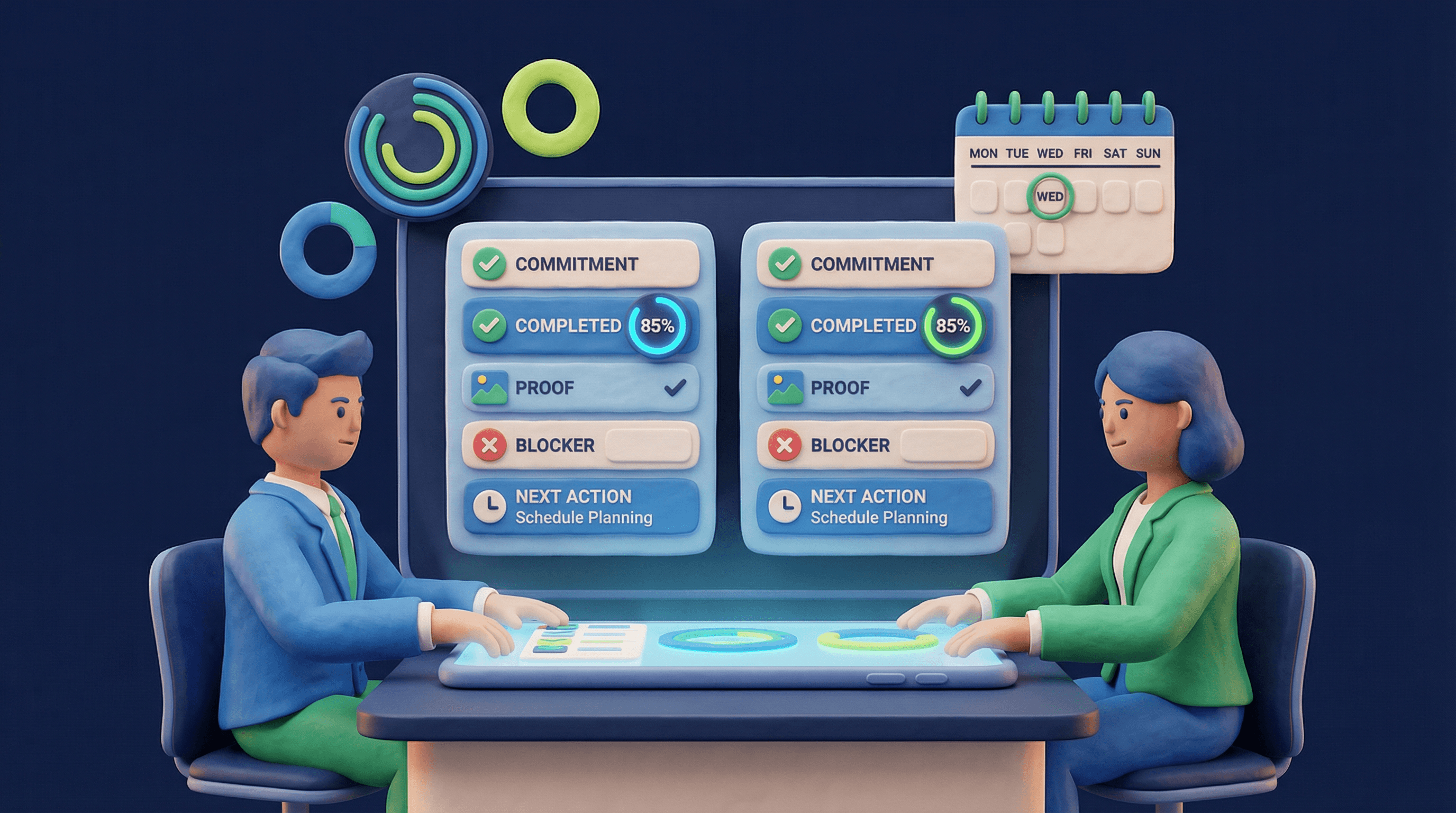
Each check-in should include:
- What you committed to
- What you completed
- Proof (photo, screenshot, link, tracker)
- Next action
4) Add Consequences and Rewards
Accountability gets stronger when actions have stakes.
Examples:
- Missed check-in = donate $10 to a cause you dislike
- 2-week streak = meaningful reward (not goal-sabotaging)
Keep stakes simple and immediate.
5) Review and Adjust Weekly
A structured weekly review is essential. Every week, answer:
- What worked?
- Where did I resist?
- What friction can I remove?
- What should I simplify next week?
You don’t need a perfect system. You need a system that adapts.
How to Choose the Right Accountability Partner
Choosing the right partner is critical to success. For a deep dive, read our complete guide on picking the right accountability partner. A good partner is not just “supportive.” They are:
- Consistent: They show up at agreed times
- Honest: They challenge excuses kindly
- Structured: They care about metrics, not vague updates
- Reciprocal: Both sides commit equally
Avoid partners who disappear, over-criticize, or treat accountability like casual chat.
A Simple Check-In Script (Copy/Paste)
Use this format inside your accountability circle:
- Today’s commitment:
- Completed:
- Proof:
- Blocker:
- Tomorrow’s action:
This keeps updates short, objective, and action-focused.
Common Accountability Mistakes (And Fixes)
Mistake 1: Too many goals at once
Fix: One primary goal for 30 days.
Mistake 2: Vague reporting
Fix: Always include measurable proof.
Mistake 3: Missing once, then quitting
Fix: Use the “Never Miss Twice” rule.
Mistake 4: Partner mismatch
Fix: Replace quickly if consistency is low.
Mistake 5: Overly ambitious plans
Fix: Shrink scope until success is boringly repeatable.
30-Day Accountability Challenge (Starter Plan)
If you’re ready now, use this:
- Choose one goal
- Set a daily minimum action
- Do 5 check-ins per week
- Submit proof each check-in
- Review every Sunday
By Day 30, you’ll have something more powerful than motivation: evidence that you execute.
Final Takeaway
Accountability is not about pressure. It’s about structure.
When your commitments are visible, measurable, and shared, consistency stops feeling like a personality trait and starts behaving like a process.
Build the process once. Then let it carry you.
FAQ
What is the best accountability system for beginners?
Start with one goal, one partner, and short daily check-ins with proof. Keep it simple for the first 30 days.
How often should accountability check-ins happen?
For most goals, 3-7 times per week works best. Daily is ideal when resistance is high.
Can accountability work without a partner?
Yes, but results are usually stronger with social commitment. If solo, use public commitments or automated check-in tools.
What kind of proof should I share?
Photos, screenshots, completion logs, calendar records, or links—anything objective and hard to fake.
 Share this article
 Twitter
 LinkedIn
 Facebook
 Related Articles