Accountability
Why Most Accountability Partnerships Fail (and How to Build One That Lasts)
Most accountability partnerships die within 2 weeks. Learn the 5 reasons they fail and a durable framework with proof-based check-ins and recovery protocols that actually lasts.
 4 min read
A lot of accountability partnerships start with high energy and die quietly in two weeks.
Not because people are lazy. Because the structure is weak.
If your system depends only on motivation, it collapses the first time life gets chaotic.
Why Accountability Partnerships Usually Fail
Most failed partnerships share the same issues:
- No clear expectation — nobody knows what “showing up” actually means.
- Uneven effort — one person takes it seriously, the other treats it casually.
- Vague check-ins — updates become “I’ll do better tomorrow.”
- No recovery plan — one miss turns into a week-long spiral.
- No consequence — missing commitments feels free.
The fix is simple: define the system before you test your willpower.
The Durable Accountability Framework
Use this 5-part setup with your partner.
1) Define the contract
Each person answers:
- What is my specific goal?
- What counts as a completed day?
- What is my minimum action on bad days?
- How many check-ins per week?
If this isn’t written down, it isn’t real.
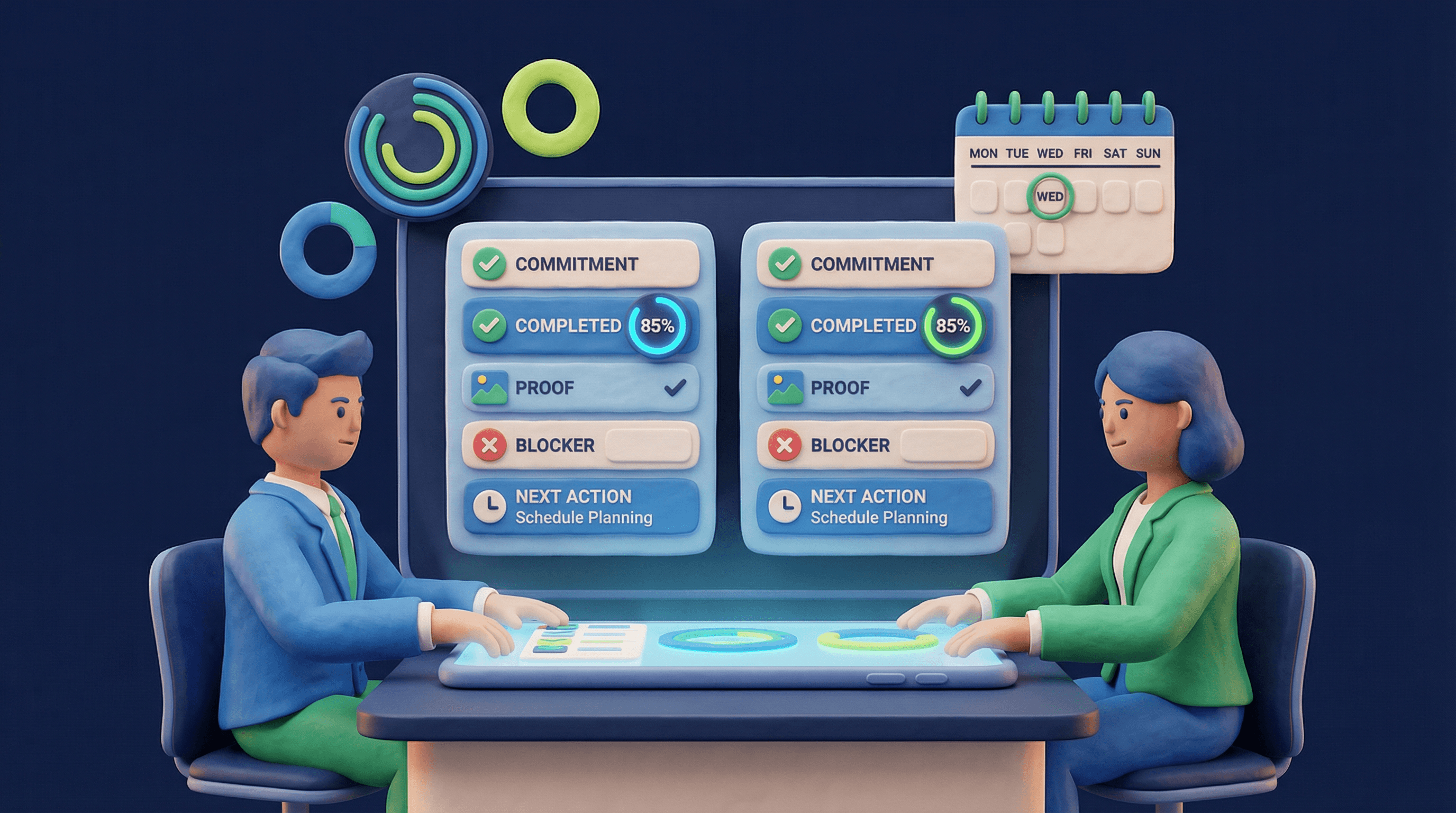
2) Use objective proof
“Done” is not proof.
Use photos, screenshots, logs, links, or timestamps. Objective proof reduces arguments and self-deception.
3) Set a fixed check-in rhythm
Don’t negotiate daily. Pick a schedule once:
- Daily for hard habits
- 3–5x/week for medium habits
- Weekly for long projects
Consistency beats intensity.
4) Add lightweight consequences
Stakes create seriousness. Keep them simple:
- Missed check-in = donate $10
- Two misses = extra accountability review
No shame. Just structure.
5) Build a repair protocol
Everyone misses eventually. What matters is recovery speed.
Use:
- Never Miss Twice
- Quick debrief: what failed, what friction to remove
- Smaller minimum action for next 48 hours
Partner Selection Checklist
For a more detailed guide, see how to pick the right accountability partner. At minimum, choose someone who is:
- Reliable with time
- Honest without being harsh
- Focused on outcomes, not excuses
- Willing to be held to the same standard
Avoid partners who disappear, over-criticize, or want accountability without accountability.
Copy/Paste Weekly Review
At week end, each person shares:
- Wins this week
- Missed commitments
- Root cause of misses
- Rule to improve next week
- First action tomorrow
This keeps the partnership adaptive, not emotional. Use our full weekly review template for a more detailed structure.
Final Takeaway
A strong accountability partnership is not about pressure. It’s about predictable structure.
When commitments are clear, visible, and shared, consistency becomes much easier.
That’s exactly the system DuoGoals is designed to support.
FAQ
Why do accountability partnerships fail?
The five most common reasons are: unclear expectations about what "showing up" means, uneven effort between partners, vague check-ins without proof, no plan for recovering from misses, and no real consequences for skipping commitments.
How do I fix a failing accountability partnership?
Start by having an honest conversation about expectations. Define what counts as a completed day, what proof looks like, and what happens when someone misses. If the partnership doesn’t improve within one week of setting clear rules, it may be time to find a new partner.
What makes accountability partnerships last long-term?
Structure, not motivation. The partnerships that last have written agreements, fixed check-in schedules, proof requirements, repair protocols for misses, and regular weekly reviews. When both people follow the same system, the partnership becomes self-sustaining.
Should I end an accountability partnership that isn’t working?
Yes — and sooner rather than later. A bad partnership is worse than no partnership because it teaches you that accountability doesn’t work. In reality, the structure was wrong. End gracefully, learn what didn’t work, and build a better system with a new partner.
 Share this article
 Twitter
 LinkedIn
 Facebook
 Related Articles