Habits
The Science of Building Habits That Actually Stick
Why do some habits stick while others fade? Discover the neuroscience of habit formation, the habit loop, and how accountability partners accelerate lasting behavior change.
 5 min read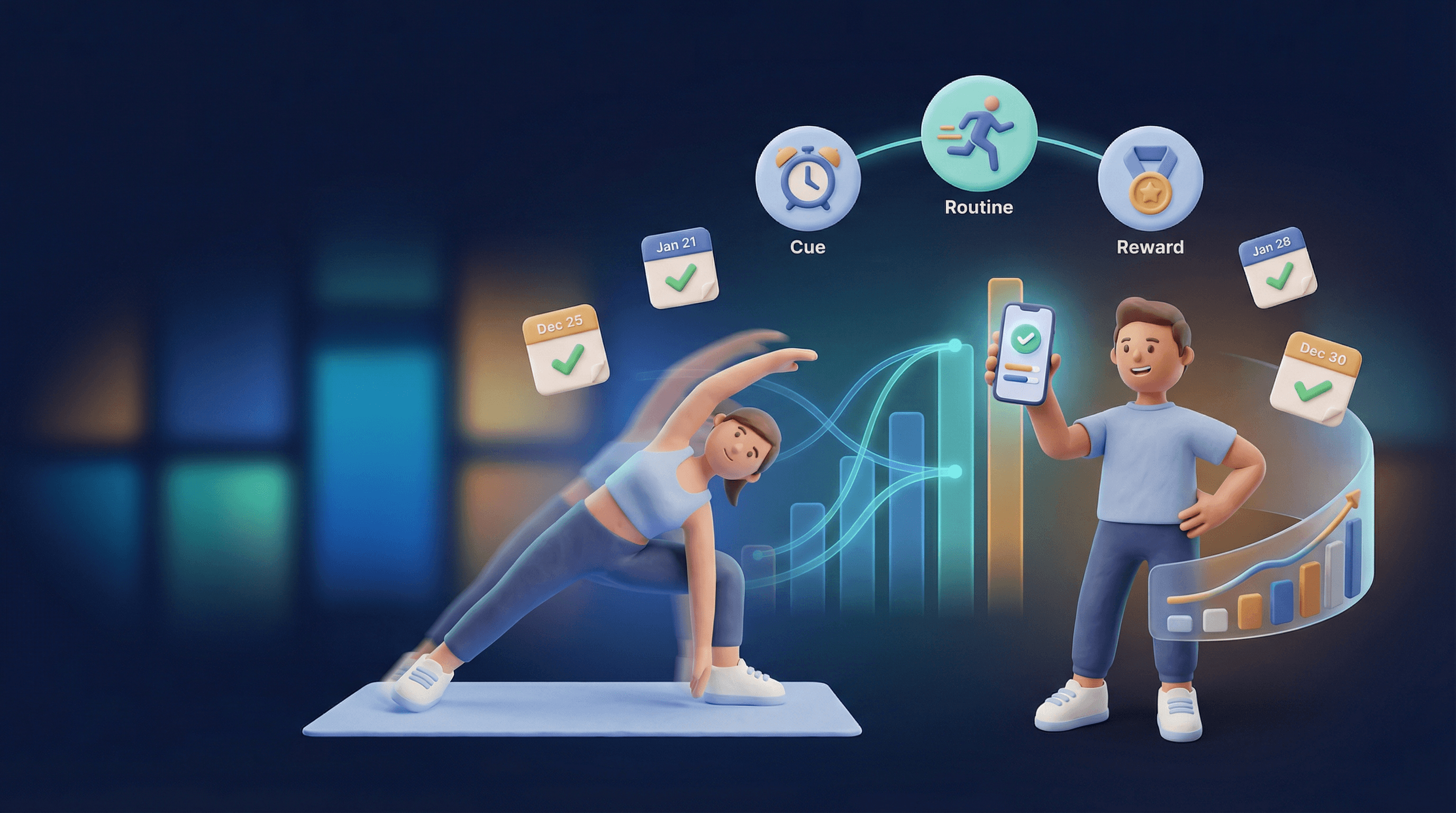
Why do some habits stick while others fade after a few weeks? The answer lies in understanding how our brains actually work. Let's dive into the neuroscience of habit formation and discover how accountability accelerates the process.
The Habit Loop
Every habit follows a simple three-step loop identified by researchers at MIT:
- Cue - The trigger that initiates the behavior
- Routine - The behavior itself
- Reward - The benefit you gain from the behavior
Understanding this loop is the first step to hacking your habits.
Why 21 Days is a Myth
You've probably heard that it takes 21 days to form a habit. That's actually a misquote from a 1960s book about self-image. Modern research from University College London found that habit formation takes anywhere from 18 to 254 days, with an average of 66 days.
The variance depends on:
- Complexity of the habit
- Your current lifestyle
- Environmental factors
- Consistency of practice
The Role of Dopamine
When you complete a habit, your brain releases dopamine—the "feel good" neurotransmitter. This creates a positive feedback loop that makes you want to repeat the behavior.
But here's the catch: dopamine release decreases over time if the reward stays the same. That's why the excitement of a new workout routine fades after a few weeks.
How Accountability Supercharges Habit Formation
Enter accountability. When someone else is counting on you:
- Your brain activates social reward circuits
- You experience heightened dopamine from social approval
- The pain of disappointing someone adds negative reinforcement
- Check-ins create external cues that trigger your habit loop
This is why accountability partners are so powerful—they tap into primal social mechanisms that have evolved over millions of years.
The Four Laws of Behavior Change
James Clear, author of Atomic Habits, outlines four laws for building habits:
1. Make it Obvious
Create clear cues in your environment. Put your running shoes by the bed. Set your meditation cushion in plain sight.
2. Make it Attractive
Bundle habits with things you enjoy. Listen to your favorite podcast only while exercising. Have your coffee only after journaling.
3. Make it Easy
Reduce friction. Start with "two-minute versions" of habits. Read one page, not one chapter. Do one pushup, not fifty.
4. Make it Satisfying
Create immediate rewards. Track your progress visually. Share your wins with your accountability partner.
The Power of Identity-Based Habits
Instead of focusing on outcomes ("I want to lose 20 pounds"), focus on identity ("I am someone who takes care of their health"). When your habits align with how you see yourself, they become automatic.
Ask yourself: "What would the person I want to become do in this situation?"
Environment Design
Your environment shapes your behavior more than your willpower. Design your space to make good habits easier and bad habits harder:
- Remove friction from good habits (keep healthy snacks visible)
- Add friction to bad habits (delete social media apps from phone)
- Create dedicated spaces for specific activities
The Accountability Check-In Protocol
For maximum effectiveness, follow this check-in structure with your partner:
- Share your intention - What you plan to do
- Provide proof - Photo, screenshot, or evidence
- Reflect briefly - What went well? What was challenging?
- Set next target - What's the next milestone?
Keep check-ins brief (2-3 minutes) but consistent.
Handling Setbacks
Missing one day doesn't break a habit—missing two does. This is called the "Never Miss Twice" rule. When you slip:
- Don't catastrophize
- Identify what went wrong
- Restart immediately
- Tell your accountability partner
The key is reducing the time between setback and restart.
Building Habit Stacks
Once you've established one habit, you can "stack" new habits on top:
- After I [CURRENT HABIT], I will [NEW HABIT]
- After I pour my morning coffee, I will write in my journal
- After I sit down at my desk, I will write down my three priorities
This leverages existing neural pathways to create new ones.
The 48-Hour Rule
Your motivation to start a habit is highest in the first 48 hours after deciding to change. Use this window to:
- Tell your accountability partner
- Set up your environment
- Complete your first session
- Schedule your check-ins
Don't let initial motivation fade into "I'll start Monday" syndrome.
Conclusion
Building habits isn't about willpower—it's about systems. The right environment, the right triggers, and the right accountability partner can transform any behavior from effortful to automatic.
Start small. Stay consistent. And remember: you're not doing this alone.
FAQ
How long does it actually take to build a habit?
Research from University College London shows it takes an average of 66 days — not 21. The range is 18 to 254 days depending on the complexity of the habit and your consistency. Don't get discouraged if a habit doesn't feel automatic after three weeks.
What is the most effective way to build a new habit?
Combine environment design (make it obvious and easy), habit stacking (attach the new habit to an existing one), and accountability (share your commitment with a partner). These three strategies address the biggest reasons habits fail.
Why do I keep starting habits and then quitting?
Most likely because you're relying on motivation instead of systems. Motivation naturally fades after the initial excitement. Build a structure with regular check-ins, minimum actions, and proof-of-work tracking so you stay consistent even when motivation is low.
Does having an accountability partner really help with habits?
Yes. Social commitment activates different reward circuits in the brain than solo effort. When someone else sees your progress (or your silence), you're more likely to follow through because of both social reward and the desire to avoid letting someone down.
 Share this article
 Twitter
 LinkedIn
 Facebook
 Related Articles